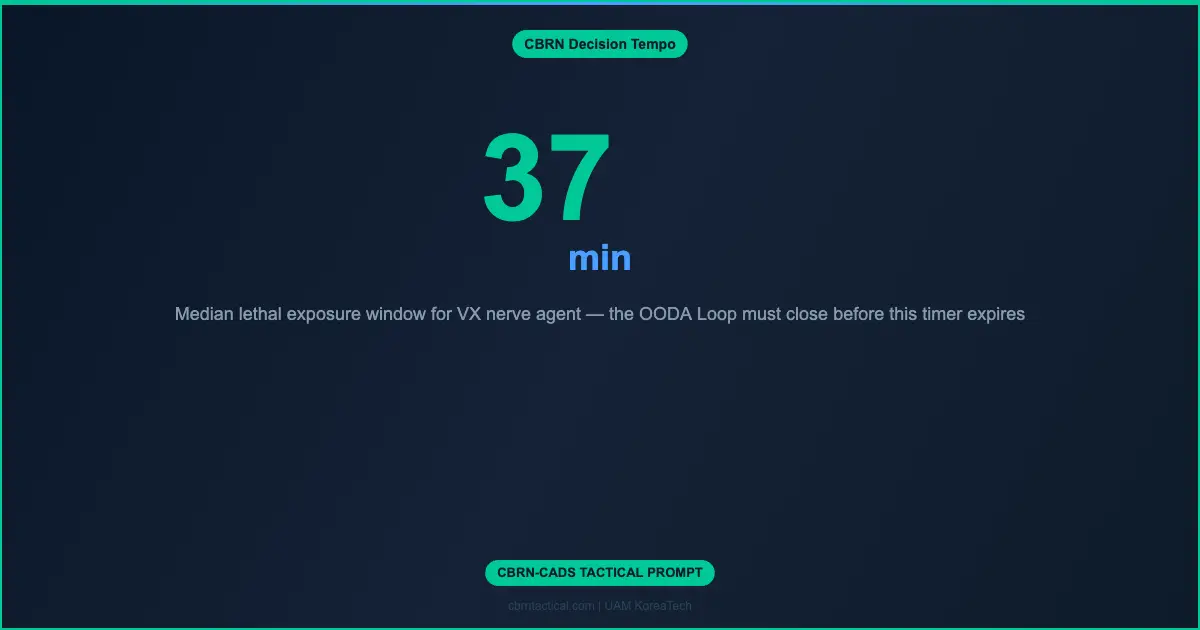
37 Minutes: The OODA Loop That Separates Life from Contamination
Colonel John Boyd’s OODA Loop revolutionized air combat decision-making. But in CBRN operations, the loop must close in 37 minutes or less — the median lethal exposure window for persistent nerve agents. CBRN-CADS compresses Boyd’s cycle from hours to seconds.
CBRN Decision Tempo
Boyd’s Unfinished Loop: When Air Combat Theory Meets Chemical Warfare
Colonel John Boyd never fought a chemical war. His OODA Loop — Observe, Orient, Decide, Act — was forged in the skies over Korea, where F-86 Sabre pilots defeated MiG-15s not through superior aircraft but through faster decision cycles. Boyd proved that the pilot who could cycle through OODA faster would always outmaneuver the opponent, regardless of hardware advantages.
But Boyd’s framework has a critical assumption: the decision-maker survives long enough to complete the loop. In aerial combat, a slow OODA cycle means losing position. In CBRN operations, a slow loop means death. When VX nerve agent contaminates a zone, the OODA clock starts at 37 minutes — the median time before irreversible physiological damage. If your detection-to-decontamination cycle exceeds 37 minutes, you don’t lose position. You lose soldiers.
The 37-Minute Clock: Why Every Second of Latency Kills
The lethality timeline for chemical agents is unforgiving. Sarin kills in 1-10 minutes through inhalation. VX — the most persistent battlefield nerve agent — penetrates skin in 10-15 minutes and reaches lethal systemic concentration in 37 minutes without decontamination. Mustard agent causes irreversible tissue damage within 2 minutes of skin contact, though death may take hours.
Against this timeline, the conventional CBRN OODA loop is catastrophically slow. Each handoff between phases introduces latency: the detection team reports to the CBRN officer, who requests lab confirmation, who informs the commander, who authorizes decon deployment, who mobilizes the decon team. Six handoffs. Each one adds 5-15 minutes. By the time the decon team arrives in MOPP-4, the 37-minute window has long closed.
D-M-D-A-V: Boyd’s Loop Rebuilt for Chemical Survival
CBRN-CADS replaces Boyd’s four-phase human loop with a five-phase autonomous pipeline where each stage feeds data directly to the next — no human bottleneck, no radio calls, no authorization delays:
→
→
→
→
The critical difference: Boyd’s OODA is a cycle — it restarts. D-M-D-A-V is a persistent loop — the Verify phase feeds back into Detect, creating a continuous monitoring state that manual teams simply cannot sustain. A CBRN soldier needs rest. A drone swarm doesn’t.
| Phase | OODA (Manual) | D-M-D-A-V (CBRN-CADS) | Time Saved |
|---|---|---|---|
| Observe / Detect | 8-12 min (M256 kit) | <90 sec (hyperspectral) | 85% faster |
| Orient / Map | 5-10 min (radio report) | 30 sec (auto-overlay) | 95% faster |
| Decide | 10-15 min (chain of command) | Instant (AI selection) | Eliminated |
| Act / Decon | 30-60 min (MOPP team) | 3-5 min (drone spray) | 90% faster |
| — / Assess | N/A (no formal phase) | 60 sec (re-scan) | New capability |
| — / Verify | N/A (one-shot) | Continuous monitoring | New capability |
| Total Loop | 53-97 min | 4-8 min | 92% reduction |
Why Tempo Wins Wars: From MiG Alley to Chemical Battlefields
Boyd’s central thesis was elegant: “The entity that can handle the quickest rate of change survives.” In MiG Alley, this meant the F-86’s hydraulic controls let pilots change direction faster than the MiG-15’s manual controls. The F-86’s kill ratio was 10:1 — not because it was faster or more armed, but because it cycled through OODA faster.
The same principle applies to CBRN with lethal precision. In Ukraine, Russian forces have used chemical munitions as area-denial weapons — not to kill en masse, but to force Ukrainian units into slow decon cycles that break operational tempo. A unit that spends 2 hours decontaminating is a unit that isn’t advancing. Chemical weapons become a time weapon, and the defender’s OODA speed determines whether they merely delay or they paralyze.
USMC Warfighting Lab
NATO JCBRN COE
DARPA Tactical Tech
Anduril Lattice
Inside the 37-Minute Window: The Future of CBRN Tempo
Boyd died in 1997, before autonomous systems could realize his vision of decision cycles measured in seconds rather than minutes. But D-M-D-A-V is the OODA Loop Boyd would have built if he’d faced chemical warfare. It preserves his core insight — faster cycles win — while adding the verification loop he never needed in air combat (because in the sky, you can see whether you hit the target).
The next evolution is predictive tempo: AI that doesn’t wait for contamination to begin the loop, but pre-positions decon assets based on threat intelligence, weather patterns, and adversary doctrine. CBRN-CADS moves from reactive OODA to anticipatory D-M-D-A-V — starting the loop before the attack, not after.
[AGENT_TYPE] = // nerve (sarin/VX), blister (mustard), blood (cyanide), choking (chlorine)
[LETHAL_WINDOW_MIN] = // time from exposure to irreversible damage
[CURRENT_OODA_TIME] = // unit’s existing detect-to-decon cycle in minutes
[AUTONOMOUS_ASSETS] = // available CBRN-CADS drones/sensors
[TERRAIN_TYPE] = // urban, open field, forested, maritime
Output: (1) Gap analysis: current OODA vs. lethal window, (2) Phase-by-phase compression plan using D-M-D-A-V, (3) Predicted autonomous loop time, (4) Survival rate improvement estimate, (5) Force posture recommendations for tempo advantage.
Leave a Reply